
Labradoodle Dog Breed Guide

If your perfect pet is a cheerful, people-focused fuzzball who loves fetch as much as cuddle time, the labradoodle might be your match. While not officially recognized by the American Kennel Club (AKC), labradoodles are an immensely popular breed hybrid that combines a Labrador retriever with a poodle. These athletic, social dogs thrive with families and singles who enjoy spending time with them and are willing to invest time and effort into training and grooming.

Energy Level

Energy Level

Prey Drive

Prey Drive

Drooling

Drooling

Shedding

Shedding

Coat maintenance / grooming needs

Coat maintenance / grooming needs

Barking

Barking

Social tendencies with people

Social tendencies with people

Trainability

Trainability

The Origins of the Labradoodle Dog Breed

The story of the labradoodle is both practical and revolutionary. In 1989, Wally Conron of the Royal Guide Dogs Association of Australia sought to combine the Labrador’s trainability and gentle temperament with the poodle’s low‑shedding, allergy‑friendly coat. The result was the labradoodle — a hybrid that quickly proved successful not only as a service dog but also as a beloved family companion. By the 1990s, labradoodles had captured global attention, sparking a surge in “designer dog” breeding and reshaping the landscape of modern canine companionship.

Group/classCross developed from the Labrador retriever and poodle
Club recognitionAustralian labradoodle clubs (ALAA, WALA)
Instincts, function and purposeLabradoodles were bred as a dog for companion and service work.
AdaptabilityLabradoodles excel with structure, exercise, enrichment and kind training. With daily exercise and mental work, apartment living can work.
Breed standardsAustralian Labradoodle Association of America (ALAA) Breed Standard, Worldwide Australian Labradoodle Association (WALA) Standard.1,2

Labradoodle Nutrition and Dog Food

Labradoodles come in a variety of sizes—from miniature to large-breed—which means their nutritional needs are not one-size-fits-all. Because of this range, it is important to choose a food tailored to your dog’s expected adult weight. For puppies expected to weigh 55 pounds or more when fully grown, a large-breed puppy formula is recommended until they reach 12 to 18 months of age to support healthy, controlled bone and joint development.

Beyond size, many Labradoodles are prone to skin sensitivities and benefit from nutrition that supports a healthy skin barrier. If your dog has a known ingredient sensitivity, your veterinarian may suggest a specialized formula featuring unique protein sources or hypoallergenic ingredients to help them stay comfortable and thrive.

Ingredients and Nutrients

The right ingredients help your Labradoodle stay healthy and active. When choosing a food, look for a complete and balanced formula featuring high-quality protein—like lamb, salmon or chicken—to maintain lean muscle. For their signature coat and healthy skin, look for omega-6 fatty acids sourced from vegetable oils and chicken fat.

Ingredients like fish oil provide the omega-3 fatty acids needed to help nourish their brain, joints and kidneys, while prebiotic fibers like fructooligosaccharides (FOS) or beet pulp help keep their digestion on track. If you are ever unsure which formula is right for your dog’s specific size or sensitivity, your veterinarian can help you choose the best option for your pet.

Life Stage Considerations

Puppies

A full-size labradoodle can take up to 18 months to mature into a full-grown adult. Smaller doodles reach maturity around 1 year of age. While labradoodle are growing, they need nutrition that supports brain and internal organ development and growing joints. Ask your vet to help you calculate feeding amounts and adjust as your puppy grows.

Adults

Adult labradoodles do best on food that meets their often-high energy needs, and complete, balanced nutrients.

Seniors

Providing the right nutrition can help labradoodles age gracefully by providing essential nutrients in an easy-to-digest formula. Many older doodles suffer from joint degeneration issues, and your veterinarian will help you determine if therapeutic nutrition can help.

Weight or joint support

Providing the right nutrition can help labradoodles age gracefully by providing Unhealthy weight gain results in increased wear and tear on joints, which can be challenging for a large-breed dog. Keep a labradoodle at a healthy weight to help ensure they're comfortable and mobile for as long as possible.

To avoid unhealthy weight gain, always measure the amount you feed them on a kitchen gram scale, limit treats to 10% of the total daily calorie count and check your dog’s body condition monthly. Your veterinarian can help you determine a healthy weight for your dog and what food is best.

Skin allergies

Some labradoodles suffer from itchy skin and/or ear infections due to skin allergies. The most common are flea, environmental, and food allergies.3

Labradoodle Dog Breed Characteristics

It’s important to remember that breed personality, physical traits, and health status are affected by a number of characteristics and may vary within the same breed; you may not see the desired characteristics in your dog.

Labradoodles can be equal parts brainy, bouncy and heart-meltingly sweet. They thrive on attention and live to please their pet parents, making them easy to train with the right motivation. They're also a popular choice among families because they're playful without being hyper and love cuddling as much as playing fetch. Labradoodles' easygoing energy is infectious — you can't help but smile when they greet you at the door.

Appearance and Physical Traits

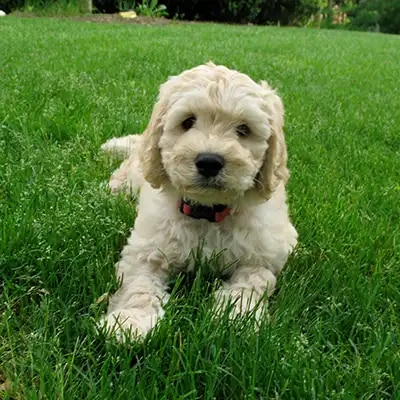
Labradoodles are mini to large dogs with a charmingly varied appearance, thanks to their Labrador retriever and poodle heritage. Their coats can range from wavy to tightly curled and come in colors like cream, chocolate, black, apricot or even parti‑colored patterns. They have a sturdy, athletic build with a friendly, approachable face framed by floppy ears, and expressive eyes that radiate warmth. Their tails are typically long and lively, wagging with enthusiasm, which perfectly matches their playful and affectionate personality.

Breed OverviewBreed Information
Breed SizeMini, medium and standard (large)
CoatFleece or wool-type coats
ColorMany solid and parti colors
Tail and EarsLong, tapered tail, floppy pendant ears
Height
  • Minis: 14 to 16 inches

  • Mediums: 17 to 20 inches

  • Standards: 21 to 24 inches

Weight
  • Minis: 15 to 30 pounds

  • Medium: 30 to 50 pounds

  • Standards: 50 to 80 pounds

Life Expectancy12 to 14 years (smaller doodles typically live longer than larger doodles)

Personality

Because labradoodles are a mixed breed, their temperament can vary depending on which traits are more dominant. But in general, labradoodles are smart dogs that are friendly and sociable when they are properly socialized as puppies. The poodle heritage contributes quick learning and sensitivity, while the Labrador in them brings enthusiasm, people-pleasing and a strong desire to retrieve whatever you throw. Early socialization plus positive reinforcement training helps channel energy into a well-mannered adult dog. Keep sessions short and fun, and add brain work like scent games and puzzle feeders. Labradoodles excel at agility training and are often used as service dogs as well.

Personality and Temperament Trait Scale

Traits are on a scale of 1 to 5, with 1 being the least and 5 being the most.

Dog TraitTrait Scale Value
Energy Level4 (High Energy) - 5 (Very High Energy)
Prey drive/chase instinct3 (Moderate Drive)
Drooling1 (Minimal Drooling)
Shedding1 (Minimal Shedding) - 4 (High Shedding)
Coat maintenance/grooming needs5 (Very High Maintenance)
Barking2 (Quiet) - 3 (Moderately Vocal)
Social Tendencies (affection toward family vs. strangers)4 (Outgoing) - 5 (Extremely Social)
Trainability4 (Highly Trainable) - 5 (Exceptionally Trainable)

Lifestyle Compatibility

Best for

Active homes that enjoy daily walks, training and play, plus regular grooming

Good with

Kids and other pets when properly socialized and supervised

Less suitable for

Low-activity or absent households or families not up for grooming

Before adopting any breed of dog, it's a good idea to speak to a veterinarian to determine if their health and care needs fit with your household, budget, and lifestyle.

Exercise Needs and Appropriate Activities

Labradoodles need exercise and mental stimulation every day. Plan on at least 60 minutes of daily activity split between up-tempo walks, training, and free play. Adult, full-size labradoodles can be good jogging partners, but it's best to wait until they are grown. Many doodles love swimming, fetch, scent games, trick training and hiking.

Training

Labradoodles are eager to please and quick learners, but they are also sensitive, so use reward-based methods and keep it positive. Avoid harsh corrections, and start early with socialization, basic cues and leash skills. When you are patient and use the correct methods, the sky is the limit when it comes to what you can teach these dogs. 

Labradoodle Dog Breed Health and Wellness

Labradoodles are generally healthy, but as a cross between two popular breeds, they can inherit predispositions to disease conditions from either side. Preventive care and weight control go a long way in supporting wellness

Potential Health Issues

Ear infections

Floppy ears, swimming and skin allergies can all contribute to ear infections in doodles. Support healthy ears by inspecting your dog’s ears regularly, keeping up with regular vet appointments and cleaning ears as recommended by your vet.4

Skin allergies

Flea, environmental and food allergies are often the cause for itchy skin and repeat ear infections. Management as recommended by your vet may include flea control, medicated bathes, allergy medication, omega-3 fatty acid supplementation and therapeutic nutrition.3

Joint disorders

Labradoodles are at risk for hip dysplasia, elbow dysplasia and cranial cruciate ligament disease. Feeding an appropriate complete and balanced dog food, keeping adults lean and regular exercise help. Be sure to speak with your veterinarian to determine the right time to spay or neuter your labradoodle.5,6

Inherited eye problems

Progressive retinal atrophy, cataracts and eyelash disorders exist in poodles.7,8 Genetic testing is possible to check for these risks.

Exercise-induced collapse (EIC)

This is a Labrador-linked genetic condition that causes dogs to collapse after intense play. Episodes can range from wobbliness to life-threatening collapse. DNA testing is available.9,10

Grooming Needs

Labradoodles may look like big teddy bears, but keeping them fluffy and soft takes commitment. While they're often touted as low-shedding breeds because of their poodle heritage, this definitely doesn't mean they're low maintenance. Plan to brush their coat several times a week for fleece and wool coats, and daily during heavy shedding seasons to prevent matting. They need professional grooming every 6-8 weeks, and baths every 4-8 weeks or as needed. Additional grooming needs include:

  • Ears: Check 1-2 times weekly for redness or odor; clean as recommended by your vet

  • Nails: Trim every 3-4 weeks or as needed

  • Teeth: Brush daily with a dog-specific toothpaste and schedule professional cleanings as advised

Pro tip: Keep a grooming go-bag with a slicker brush, comb, detangler and treats. Snacks keep the pup ratings up!

Is a Labradoodle Your New Furry Friend?

If you want a friendly, sporty companion who lives for your attention and your adventures, a well-bred, well-groomed, well-exercised labradoodle can be an absolute joy. If you provide daily exercise, brain work, patient, consistent training, great nutrition and preventive veterinary care, you will have a happy sidekick who thinks you hung the moon.

Resources For New Pet Parents

Adopt a pet. Change a life.

Pet adoption

Get expert tips for a long and happy life with your new best friend.

Dog Guide

Breed FAQs

The labradoodle coat type varies. Some don’t shed at all, many shed lightly, and some shed heavily. Regular grooming helps. Many people think these dogs are hypoallergenic, but that is a common misconception. 

With proper socialization and supervision, labradoodles can be wonderful with children. But temperament can vary depending on the dog. Always monitor children around dogs.

Labradoodles need at least 60 minutes of exercise daily, plus mental enrichment.

Labradoodles are not recognized by the AKC, however, they do have breed standards from labradoodle-specific clubs. 

References

  1. Australian Labradoodle Association of America, “Breed Standard,” Accessed Oct 15, 2025, https://alaa-labradoodles.com/for-breeders/breed-standard/.

  2. Worldwide Australian Labradoodle Association, “Australian Labradoodle Breed Standard,” Accessed Oct 15, 2025, https://www.walalabradoodles.org/about-australian-labradoodles/australian-labradoodle-breed-standard.

  3. Harvey, Naomi D., Steven C. Shaw, Peter J. Craigon, Sarah C. Blott, and Gary C. W. England, “Environmental Risk Factors for Canine Atopic Dermatitis: A Retrospective Large-Scale Study in Labrador and Golden Retrievers,” Veterinary Dermatology 30, no. 5 (2019): 396-e119, https://doi.org/10.1111/vde.12782

  4. O’Neill, D. G., T. R. Church, D. B. McGreevy, P. C. Thompson, and D. C. Brodbelt, “Epidemiology of Otitis Externa in Dogs under Primary Veterinary Care in the UK,” Canine Genetics and Epidemiology 8, no. 1 (2021): 1–16, https://cgejournal.biomedcentral.com/articles/10.1186/s40575-021-00106-1

  5. DeForge, T. L., J. M. Ball, J. V. Mochel, M. A. Conzemius, and A. J. Carr, “Age of Neutering Contributes to Risk of Cruciate Ligament Rupture in Labrador Retrievers,” Journal of the American Veterinary Medical Association 263, no. 3 (2025).

  6. Kieler, Ida Nordang, Sofia Malm Persson, Ragnvi Hagman, Voichita D. Marinescu, Åke Hedhammar, Erling Strandberg, Kerstin Lindblad-Toh, and Maja Louise Arendt, “Genome Wide Association Study in Swedish Labrador Retrievers Identifies Genetic Loci Associated with Hip Dysplasia and Body Weight,” Scientific Reports 14 (2024): Article 6090.

  7. Barnett KC, Startup FG. Hereditary cataract in the standard poodle, Veterinary Record, 1985;117(1):15–16. doi:10.1136/vr.117.1.15.

  8. Downs, Lauren M., Cathryn S. Mellersh, and David J. Sargan, “A Novel Mutation in the Canine RCD4 Gene Identified in Standard Poodles, Gordon Setters, and Irish Setters with Late-Onset Progressive Retinal Atrophy,” Canine Genetics and Epidemiology 1, no. 1 (2014): 10, https://pubmed.ncbi.nlm.nih.gov/24255994/.

  9. University of Minnesota Canine Genetics Lab, “Dynamin-1 Associated Exercise-Induced Collapse,” Accessed Oct 15, 2025, https://vetmed.umn.edu/research/research-labs/canine-genetics-lab/canine-genetics-testing/dynamin-1-associated-exercise.

  10. UC Davis VGL, “Exercise-Induced Collapse,” Accessed Oct 15, 2025, https://vgl.ucdavis.edu/test/exercise-induced-collapse.