Irish Setter Dog Breed Guide

The Irish setter is a dog breed known for being a sociable, tireless, red-headed sporting dog who can hunt all morning and still find time to nap with one paw on your knee. This joyful canine athlete wakes up ready for fresh air, training time and family hangouts. They thrive with routine, daily exercise and clear expectations, plus a predictable spot on the couch near their favorite people. Raise an Irish setter with intention and you’ll have a confident companion who can quarter a field at sunrise, greet neighbors like a celebrity by noon and snooze like a pro by evening. (Yes, they’ll also spy that single crumb under the table. What can we say? Talent is talent.)

Best For: Active pet parents who enjoy daily walks, hikes, training and time outdoors with their dog.

Less Suitable For: Sedentary, absent households with minimal exercise time or limited access to fenced areas, homes with small pets such as cats and birds.

Energy Level

Energy Level

Prey Drive

Prey Drive

Drooling

Drooling

Shedding

Shedding

Barking

Barking

Trainability

Trainability

The History of the Irish Setter Dog Breed

The Irish setter was first bred in Ireland as a bird dog to locate gamebirds by scent, then “set” — become motionless and crouched — to indicate birds in hiding for a hunter. This ability is why they are called setters. Early dogs showed more white with red patches; over time, breeders selected for the rich red coat that Irish setters are known for today. Field and show lines both exist, and responsible breeders in either camp prioritize temperament, working ability, health and sound conformation. The American Kennel Club recognized the breed in the late 19th century, and the modern Irish setter remains a swift, stylish gundog and amiable housemate.

Breed AttributeAttribute Details
Group/ClassSporting Group (AKC), Gun Dog Group (UKC)
Club RecognitionAmerican Kennel Club, United Kennel Club, Irish Setter Club of America
Instincts, Function and PurposeIrish setters were originally bred as hunting dogs.
AdaptabilityIrish setters are highly adaptable, but they thrive with daily routine and exercise.
Breed StandardsIrish Setter Club of America Official Standard, UKC Official Standard

Nutrition for Irish Setters

Irish Setters are spirited, medium-large sporting dogs that thrive on a complete and balanced dog food containing essential vitamins and minerals to sustain their signature athleticism. These nutrients help maintain lean muscles, support joint health and provide steady energy for their naturally active, adventurous lifestyle

Ingredients and Nutrients

Irish setters are large, athletic dogs that do best on complete and balanced dog food that supports lean muscle, joint comfort, digestive health and skin and coat quality. It is recommended that you ask your veterinarian to help you determine the best food for your dog, as well as appropriate calories, portion sizes and feeding schedule for your dog’s age and activity level.

Life Stage Considerations

Puppies: Irish setters puppies can take 12 to 18 months to reach full maturity. While they are growing, they need to eat a large-breed puppy food that has controlled calcium and phosphorus levels and energy. Ask your vet when is the best time to switch from a puppy formula to an adult formula.  

Adults: Adult Irish setters benefit from a large-breed adult formula that matches activity level, with calories and nutrients to maintain ideal body condition. Look for a formula that also supports gut and joint health.

Seniors: Older Irish setters benefit from highly digestible formulas that contain brain-and-joint support nutrients and controlled calories to protect mobility and body condition. Omega-3 fatty acids from fish oil and antioxidants can help promote your senior Irish setter's healthy aging.

No matter what life stage your dog is in, your vet is your most valuable resource when it comes to choosing the right dog food and portion for your furry friend. Talk with them before making any feeding decisions for your pet.

Breed-specific dietary concerns: A subset of Irish setters has gluten-sensitive enteropathy. Your vet can help determine if a gluten-free food is appropriate for dogs with chronic digestive problems.4

Weight management and joint health: Unhealthy weight gain can cause increased wear and tear on the body which impacts longevity and mobility. Work with your vet to determine your dog’s ideal body condition and calculate daily calorie targets. Limit treats and pet-safe people food to less than 10% of daily calories. 

Irish Setter Characteristics

Irish setters are typically joyful and sociable hunters. They value family and routine. These highly adaptable sporting dogs work hard and rest hard. Their dynamic nature and their telltale red coats are among key identifiers of the Irish setter breed.

Appearance and Physical Traits

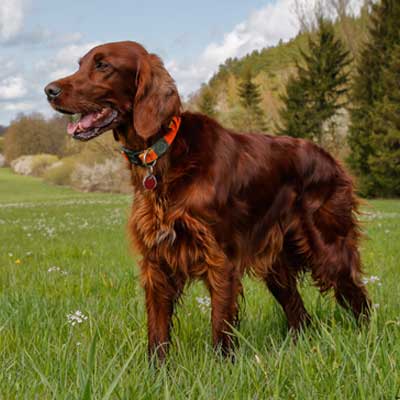
The Irish setter dog breed is known for their elegant, athletic frame, long clean lines and deep chest that reflect their history as a tireless field companion. Their expression is bright, curious and full of eager intelligence. The breed’s signature flowing red coat is flat or slightly wavy and requires regular brushing. Irish setters are balanced, athletic, agile and beautiful.

Physical TraitTrait Details
Breed SizeLarge
CoatFlat to slightly wavy, with feathering on ears, chest, belly, legs and tail
ColorsRich red (mahogany to chestnut), small white markings allowed
Tail and EarsTail carried level or slightly below back, ears set well back and low
Height27 inches (males); 25 inches (females)
Weight70 pounds (males); 60 pounds (females)
Life Expectancy12 to 15 years

Irish Setting Temperament and Personality Traits


Irish setters are affectionate, people-oriented dogs. A well-raised Irish setter is curious, confident, sociable and eager to please. They tend to greet guests like long-lost friends and will follow you from room to room. Irish setters often carry objects, especially soft things like shoes, socks or plush toys, as comfort, a request for attention and hunting instinct.

Setters are bred to work in the field, so they do best with daily jobs, whether that is field work, scent games or regular obedience or trick training. Without that outlet, they can invent hobbies that may not align with your home or yard decor. Many Irish setters mature a little later than some breeds, which means patience and a sense of humor go a long way during adolescence, which can last until they are a year and a half; some experts say they don't settle down until at least 3 years of age.

Prey drive is real for an Irish setter (hunting dog, remember!), so supervise them around small pets; they are not recommended for homes with birds. Channel chase into appropriate outlets. This breed tends to handle new places and people with enthusiasm, though confidence-building with socialization in controlled positive environments should still start early.

With clear rules, early socialization and positive training, Irish setters grow into confident, mannerly companions who love to work, then crash at your feet.

Personality and Temperament Trait Scale

Traits are on a scale of 1 to 5, with 1 being the least and 5 being the most.

Personality TraitTrait Scale
Energy Level5 - Very High Energy
Prey Drive4 - High Drive
Drooling2 - Low Drooling
Shedding4 - High Shedding
Coat Maintenance4 - High Maintenance
Barking3 - Moderately Vocal
Social Tendencies4 - Outgoing
Trainability4 - Highly Trainable

Note: These rankings describe general tendencies. Dogs, like people, are individuals and their behavior and personality can vary based on genetics, environment, health, and training.

Lifestyle Compatibility

Before adopting any breed of dog, it's a good idea to speak to a veterinarian to determine if their health and care needs fit with your household, budget and lifestyle. Understanding common veterinary needs can also help you decide if they are a good fit for your home.

Best for: Active pet parents who enjoy daily walks, hikes, training and time outdoors with their dog.

Good with: Singles or families with children who commit to socialization, supervision and enrichment.

Less suitable for: Sedentary, absent households with minimal exercise time or limited access to fenced areas, homes with small pets such as cats and birds.

Exercise Needs and Activities

Irish setters need 60 to 90 minutes of combined physical and mental activity every day. Brisk leash walks, hiking, swimming, field work, nose work, retrieval and scent games and obedience or rally all fit the bill. These dogs are smart and were built to move with purpose, so mix up routines to keep them excited to learn.

Avoid repetitive high-impact work and long-distance running in puppies and young Irish setters until growth plates are closed — work with your vet to determine when this occurs. In hot weather, schedule exercise for cool hours and offer shade and water.

Training Tips

Irish setters crave interaction, so training time doubles as bonding time. Invite them to help with daily activities. Irish setters are clever, so vary locations, toys and rewards to keep their mind engaged. Honor their birddog heritage with field-style training games that allow short bursts of chase, then reward returning to you with a quick restart of the game. Use scent games, like locating hidden scented objects, to satisfy instinct while reinforcing focus.

Cooperative care is important.  Practice gentle paw handling and nail trims, mouth and ear checks, quiet brushing sessions and positive introductions to grooming tools so they learn to relax and participate.

Irish Setter Health and Wellness

Irish setters are generally healthy; yet, like many sporting breeds, they face certain risks. Manage their weight, provide year-round parasite control, schedule regular veterinary checkups and discuss the timing of spaying or neutering with your vet to allow healthy skeletal growth and maturity.

Potential Health Issues

Epilepsy: The breed is predisposed to idiopathic epilepsy, typically appearing between 6 months and 3 years of age.

Progressive retinal atrophy: An early-onset form of PRA in Irish setters is caused by mutations in the PDE6B gene. DNA testing is available.3

Gastric dilatation-volvulus (GDV), also known as bloat: Due to their deep chests, the stomach can fill with gas and twist, cutting off blood flow. This is a life-threatening emergency that can be fatal in minutes. Consult with your vet about a prophylactic gastropexy to minimize the severity of this issue. 

Gluten-sensitive enteropathy: A well-described inherited gut condition in Irish setters that has served as an animal model for human celiac disease. Management involves strict dietary control under veterinary guidance.4

Orthopedic issues: All large-breed dogs are at risk of developmental joint disorders like hip and elbow dysplasia. Feed puppies large-breed puppy formulas, keep them lean and avoid high-impact exercise until they are done growing. Consult with your vet on early screening. 

Grooming

The Irish setter's feathered coat needs regular care, not constant fussing. Brush two to three times weekly to remove loose hair and prevent mats behind ears, under the elbows and in feathering. Comb out burrs after field time. Setters shed moderately year-round, but you’ll see higher shedding peaks in spring and fall. Bathe as needed with a gentle dog shampoo. Check ears weekly, especially after swimming, and clean only as directed by your vet. Trim nails every three to four weeks or as needed. Brush teeth every 24 hours with enzymatic dog toothpaste to control plaque and tartar. 

As with any dog, your vet is your best resource if you have questions about care needs for your dog (or one you're planning to adopt).

Is the Irish Setter Your New Furry Friend?

If you are hoping for a canine companion who runs beside you, learns quickly and then flops down like rest is an Olympic sport, the Irish setter might be your perfect partner. Give them consistent exercise, intentional training time and regular affection, and they will give you joy, goofy grins and the kind of loyalty that makes every day feel like a win. If you find a few artfully placed muddy paw prints charming, you are already halfway there.

Resources For New Pet Parents

Get expert tips for a long and happy life with your new best friend.

New dog guide

Irish Setter FAQs

Yes. Irish setters do best with daily physical exercise and mental enrichment. Plan on 60 to 90 minutes split across walks, training and games.

With thoughtful introductions, supervision and training, many Irish setters live peacefully with other dogs. Always go slowly with small pets such as cats and birds because of their prey drive.

Yes. Expect moderate year-round shedding and a bit more seasonally. Regular brushing helps.

Usually not. Most communicate in softer ways. Some will “tell you stories,” which is part of the charm.

References

  1. American Kennel Club, “Official Standard for the Irish Setter,” Accessed October 27, 2025, https://images.akc.org/pdf/breeds/standards/IrishSetter.pdf.

  2. Miyadera, K. 2014, “Inherited Retinal Diseases in Dogs: Advances in Gene/Mutation Discovery,” Human Genetics 133 (6): 617–636, https://pmc.ncbi.nlm.nih.gov/articles/PMC4480793/.

  3. Hall E.J. & Batt R.M, “Dietary Modulation of Gluten Sensitivity in a Naturally Occurring Enteropathy of Irish Setter Dogs,” Gut 33 (2): 198–205, https://doi.org/10.1136/gut.33.2.198.

Dr. Jessica Seid Dr. Jessica Seid

Jessica Seid is an emergency veterinarian practicing in the New England area. She is a graduate of the North Carolina State College of Veterinary Medicine and has been in the field for more than a decade. When she's not helping patients, she enjoys spending time with her husband, daughter and French bulldog.